From café cantante to tablao
Madrid's flamenco rooms, then and now
How flamenco moved from the cafés cantantes of the 19th century to today's small tablaos, and where a room like Café Ziryab fits.
Reserve your flamenco hour ↗Quick answer
Flamenco turned professional in Spain's cafés cantantes, which ran from the mid-1800s into the 1920s. Tablaos took over from them across Spain in the 1960s. Madrid had its own cafés cantantes, and Café Ziryab sits in that line: a café with a small stage, a drink and a lineup that changes weekly.
Flamenco before the stage
Flamenco's earliest written trace is José Cadalso's 1774 book Las Cartas Marruecas, according to Wikipedia, and the genre's name first appears in an 1847 article from El Espectador, which labelled it a Gitano genre. UNESCO, which inscribed flamenco in 2010, calls Andalusia its heartland. Before there were stages, flamenco belonged to festivals, rituals, church ceremonies and private celebrations, to families and to clubs, passed on through dynasties and social groups.
Madrid takes a liking
Wikipedia's article on flamenco describes a taste for Andalusian romantic culture which triumphed in the Madrid court, and it notes a Gitano party in Madrid that was already clearly identified as flamenco. The art was therefore not an exotic import in the capital for long. Madrid was also home to writers who attacked it. Eugenio Noel, a Madrid writer, is named as the greatest standard-bearer of the campaign against flamenco, which shows how loudly the art was argued over.
The café cantante
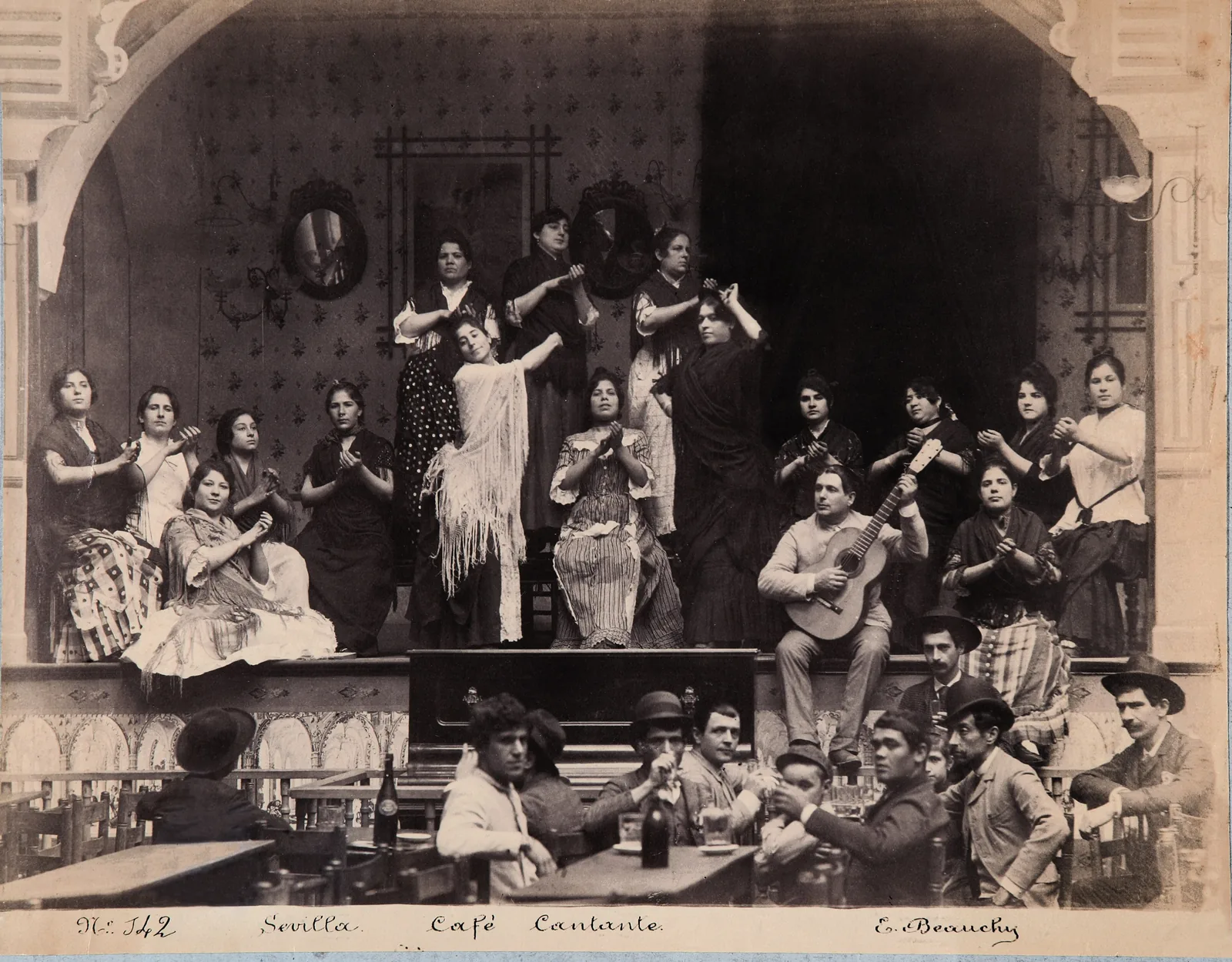
Wikipedia says cafés cantantes became the centre for professional flamenco performances from the mid-19th century to the 1920s. These were cabaret-style bars where artists performed on a platform at the rear and customers sat at tables to drink. The article gives the Café de las Salesas in Madrid as an example. The photograph above shows a Seville café cantante around 1888, which makes the point: flamenco as a paid, seated performance dates back far more than a century.
Seville's first singer café
Wikipedia credits the singer Silverio Franconetti with opening the first flamenco singer café in Seville, and it ties the golden age of the genre to artists such as Antonio Chacón. The details of who sang where are a specialist's subject. For a visitor the useful point is simpler: the café was where flamenco became a profession, with a stage, an audience at tables and artists paid to perform.
The tablao arrives
Tablao is a colloquial form of tablado, a floorboard or platform. Wikipedia says tablaos appeared across Spain in the 1960s and took the place of the cafés cantantes. In the older cafés the tablao was the rear area where artists performed. Venues are usually decorated in a Spanish style, with embroidered silk shawls, photographs of famous people and bullfighting items, and many serve drinks, with tapas or full meals on offer in some.
Reading a modern ticket
Wikipedia warns that tablao pricing can be confusing and may include an entrance fee, and that it varies by location. The practical lesson is to read what a ticket includes before you pay: whether a drink is part of it, whether food is served, and how long the show lasts. At Café Ziryab the answers are short: about an hour, one drink, and cold tapas on sale. Other rooms offer a full dinner and a longer evening, which is a different night.
A café again
The Madrid tourism board describes Café Ziryab as a tablao in the Acacias area, with a simply decorated room designed to focus attention on the stage. It offers original and innovative acts, traditional flamenco and recitals of music and song. The café itself says its regular show draws on the old cafés cantantes, and that guitarists, singers and dancers share the stage in a close and natural format. In other words, it is a deliberate return to the café stage, with a modern lineup.
Who this isn't for
This guide is history. It will not tell you what to book on a given date, and it names no rival rooms. If you want a large production with a company of many dancers, a tablao with dinner is a different night. If you want to see where modern flamenco came from, a small room with a changing lineup is a good place to start.
Read next: A first flamenco hour: what to hear
Frequently asked questions
What is a café cantante?
A cabaret-style bar where flamenco was performed from the mid-19th century to the 1920s, according to Wikipedia. Artists performed at the rear while guests sat at tables.
What is a tablao?
A venue where flamenco shows are performed. The word is a colloquial form of tablado, a floorboard or platform, and tablaos replaced cafés cantantes from the 1960s.
Is Café Ziryab a tablao?
Yes. The Madrid tourism board lists it as a tablao in the Acacias area, and the café says it belongs to ANTFES, the national association of flamenco tablaos.
Sources