A listener's first hour
A first flamenco hour: what to hear
A plain-language listening guide to a first flamenco show: the three parts of the art, how the counting works, six common forms and small-room manners.
Reserve your flamenco hour ↗Quick answer
Flamenco joins song (cante), guitar (toque) and dance (baile). Each form, or palo, has its own mood and counting pattern, called a compás. Soleá and seguiriya are solemn and run on twelve beats. Tangos are fast and festive on four. In a small room such as Café Ziryab the café asks for silence during the show.
Three parts, one art
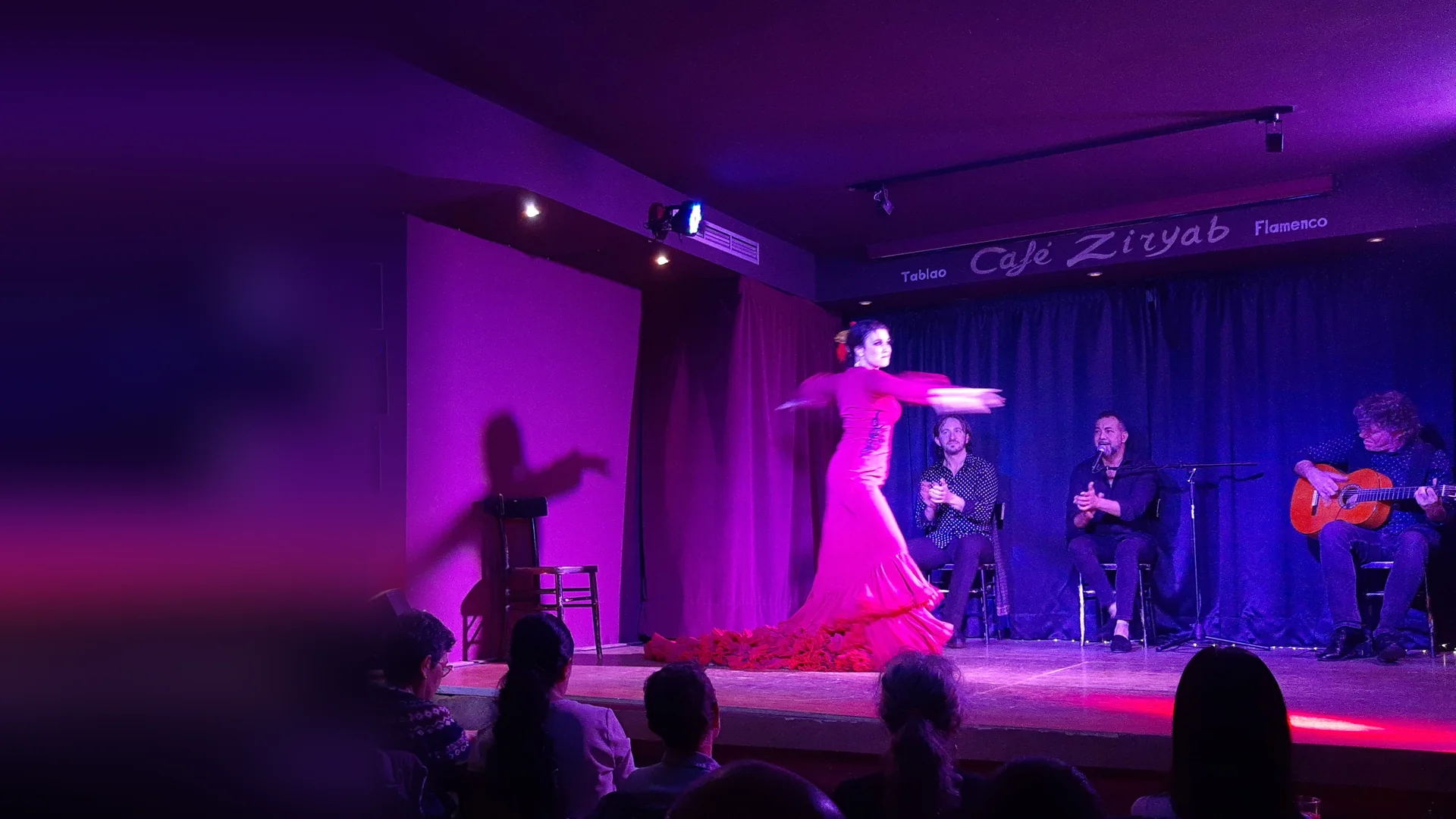
UNESCO's entry treats flamenco as three arts in one: song (cante), dance (baile) and instrumental playing (toque). Singers, men and women alike, ideally sit. The dance carries passion and courtship. The guitar now does far more than accompany. Castanets, hand-clapping and foot-stamping appear too. For a first show, listen to each in turn: the voice first, then the guitar underneath, then the feet.
The compás
Every form rests on a repeating pattern of beats, the compás. Wikipedia lists the soleá family and the seguiriya group as twelve-beat cycles, and the tango family as four-beat. You do not need to count. After a few minutes you feel when a phrase resolves and the next begins, much as you feel the end of a line in a song without counting syllables.
Palmas, the handclaps
Palmas are handclaps that render the compás when no guitarist is present, according to Wikipedia, and UNESCO lists hand-clapping among flamenco's sounds. In the photograph at the top of this page, two of the artists clap from their chairs while the dancer turns. The claps belong to the performers. Café Ziryab's own site asks guests to stay silent and not to clap, so let the artists keep the rhythm and save your applause for the end.
Six forms to recognise
Soleá is solemn and slow, part of the deep song, or cante jondo, family. Seguiriya shares the twelve beats with different accents and a graver mood. Tangos are fast and festive. Tientos are a slower, more syncopated form of tangos. Guajira is a round-trip form that travelled to Cuba and back. Fandango began as a folk dance popular in 18th-century Spain and Latin America. The home page of this site gives a short note on each.
Deep song and festive song
Wikipedia sets the solemn deep songs against the fast and festive tangos, and the contrast is the easiest thing for a new listener to hear. Programmes can move between the two moods, a heavy piece and then a lighter one. You will feel the difference in the clapping, in the guitar's attack and in how the singer holds a note. If a piece sounds grave, the room usually grows quieter with it.
The dancer's side
The dancer answers the singer and the guitar with the feet. Wikipedia notes that a guitarist needs strong volume to be heard over the sound of the dancers' nailed shoes, which tells you how loud the footwork can be. In a small room you will feel it through the floor as well as hear it. Footwork, handclaps and falsetas, the guitar's melodic passages, are listed together as part of flamenco's forms.
What a small room changes
At Café Ziryab the lineup changes every week, and the café says improvisation is essential to each performance. So you may hear any of the forms above, in a different order, or none of them by name. A close room lets you see the guitarist's right hand and hear a dancer's breath. The venue puts the show at about an hour. Allow the first minutes to tune your ear before you judge.
Read next: Café Ziryab tickets and what they cover
Who this isn't for
If you want a seated dinner and a spectacle, the wrong guide. If you cannot sit quietly for an hour, think twice. Everyone else can come with no preparation at all: you do not need to know a palo by name to feel what the room is doing. Read the notes above as a map you can put away once the lights change. The artists, not the guide, set the pace, and the best preparation is to arrive calm, early and ready to listen. If a piece surprises you, that is the point of a live room.
Frequently asked questions
Do I need to know Spanish?
No. Flamenco is felt through voice, guitar and movement. The words matter less than the phrasing, and the artists carry the meaning with their bodies.
What is a palo?
Palo is the word for a single flamenco form, each with its own mood and counting pattern, per Wikipedia.
Should I clap along?
Not at Café Ziryab. The café's site asks guests to stay silent during the show and not to clap. Follow the room.
Sources